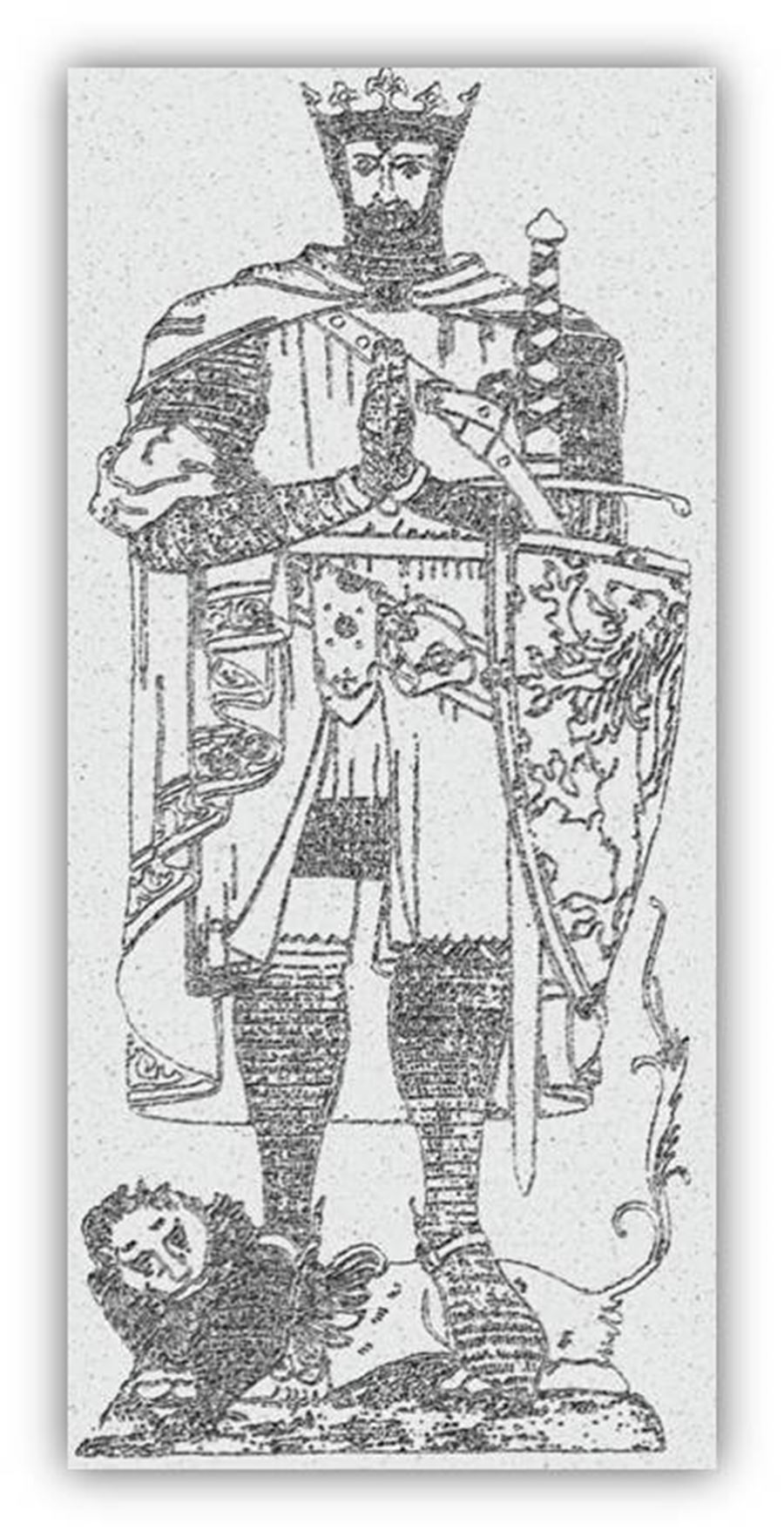
Robert the Bruce, crowned King of Scotland 1314, died 1329. Brass rubbing from Dunfermline Abbey © Tarbert Castle Trust
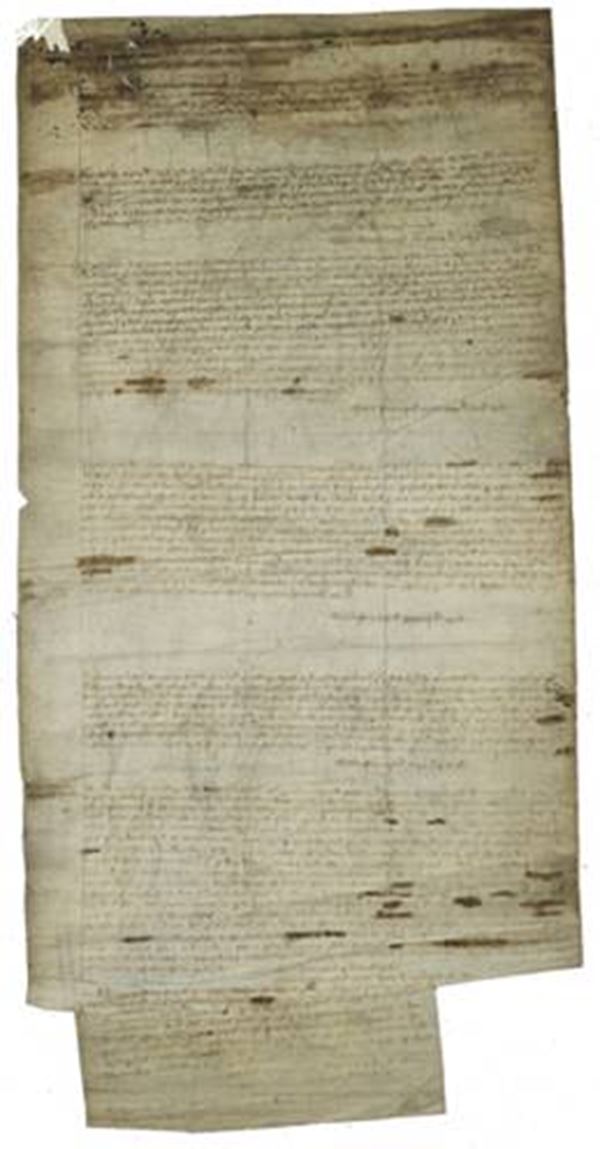
Photograph of the original accounts recorded for King Robert the Bruce for the rebuilding and extending Tarbert Castle
Tarbert Castle (continued)
A royal stronghold
The first building of the castle we see today is likely to be work commissioned by King Alexander II, c1223. The present inner bailey has strong architectural similarities to the castles at Kinclaven and Kincardine also built during Alexander’s reign. This Royal castle, guarding the anchorage below and controlling the land link between Tarbert's East and West Lochs, would have helped defend access to Knapdale and Loch Fyne along with Kintyre and the surrounding islands
In 1292, the castle was granted to John Balliol by Edward I of England.
In 1325 King Robert the Bruce, realizing the strategic importance of the isthmus and the necessity to defend it, set work in hand to repair and extend the existing square enclosure. The curtain wall was extended to surround a much larger area, and two drum towers built on the eastern side. The new works included a Hall built on piers, a dwelling house, a chapel, a new kitchen, a wine house, bake house, goldsmiths’ house, malt house, brew house with a new vat, a mill with millpond and lade, a moat and a lime kiln.
It is not clear how often Bruce visited his castle but entries in the castle accounts prepared on his behalf would suggest that he stayed here again in 1329, the year of his death

Artists impression of the castle as it might have looked, in 15th-16th century (Illustration by Robert McPhail FRS) © Tarbert Castle Trust
John de Lany, Constable of Tarbert’s accounts relating to Tarbert Castle © Tarbert Castle Trust. This document is written in Latin the official court language in the 14th century and is one of the oldest in the Exchequer Rolls in Edinburgh.
From these accounts we know many of the names of people and materials involved in building the castle. A full translation of the document and detailed history is available in booklet The Royal Castle of Tarbert from Loch Fyne Gallery and Ian Y Macintyre’s shop on Harbour Street.
In 1494 James IV stayed at Tarbert Castle on two occasions during his military campaign to subdue the feuding clans of the Western Isles. Capturing Tarbert Castle from John MacDonald of Islay, Lord of the Isles. James took up residence and, in April of that year, ordered the repair of the castle. It is probable that the keep or tower house was built at this time as it has decorative stonework of a later period and gun loops confirming that munitions were now part of a defence system. Facilities were also established for his shipping, to transport artillery and a stock of gunpowder.
On James’ second visit, Parliament was summoned to meet at Tarbert on July 5th 1494, to decide ways of pacifying the still turbulent area of Kintyre and the Islands.
The castle was used again by James in 1499 as a naval supply base during his ongoing campaign to suppress the rebellious MacDonalds. After their capture at Finlaggan on Islay, John of the Isles, his son and a number of kinsmen were imprisoned at Tarbert Castle prior to their hanging on the mainland. James then made Archibald Campbell, Earl of Argyll, keeper of the castle of Tarbert. The title ‘Keeper of the Castle of Tarbert’ is still borne today by the present Duke of Argyll
The castle changed hands many times as a result of clan disputes. In 1705 the MacAlister family of Tarbert tenanted the castle under charter from the Campbells but by 1760, it fell into disrepair. Most of the useful stone was removed to build the harbour and village as Tarbert became a major fishing port.
Preserving the past
Tarbert Castle is now held in trust. Supported by Historic Environment Scotland and the Scottish Government, remains of the castle tower and walls have been stabilised, grounds cleared and the site opened up for public access by local volunteers.
Keeping the grass under control are our team of ‘green lawnmowers’, a flock of Hebridean and Soay sheep. There is also a community woodland, sculpture walk and community orchard.
A community survey carried out in 2013 successfully recorded the upstanding
castle remains in detail and was followed up by the Big Community Dig in May
and June 2019. More than 200 adults and children took part and some exciting
finds were made. These included medieval pottery, a medieval oven, a
previously unknown fortified western entrance and a coin dating back to Mary
Queen of Scots!
For more information on the Big Dig and the Castle visit Tarbert Castle
Heritage Park.
Visiting the Castle
The steps to the Castle are situated at the end of Harbour Street opposite the fish quay.