
Skiffs approaching the perch, leaving harbour

Fisher Lassies

The crew of the F.V. Mairearad
Getting ready for the day's catch
Fishing (continued)
The huge fleet of little skiffs flourished, expanded and
prospered all over the West Coast waters. In 1886 there
were 66 boats employing 272 men anchored in the
harbour and it is said you could walk from one side to
the other over the moored boats. The population of
Tarbert swelled to 2000 in the closing years of the 19th
century and seasonally this was added to by the
travelling “herring girls” who followed the shoals from
port to port. This female army assembled on the Fish
Quay at the height of the Loch Fyne season to gut, salt
and pack the catches in barrels as swiftly as possible
so that the Scottish Fisheries Crown Brand could be
stamped on the barrel to guarantee it had been packed
within 24 hours of the herring being caught.
Herring Screws
Speed of transportation to market was essential. The
usual method was for the barrels to be transported
onwards by packet steamer to Glasgow. Again the
Tarbert fleet devised a more efficient method. Bigger
vessels known as herring screws bought the catches
direct from the skiffs while at sea in Loch Fyne and
steamed straight for the rail heads at Fairley or
Glasgow. A fresh herring could be on the plate in
London or Liverpool in less than 24 hours. There were
6 ’screws’ servicing the Tarbert fleet in 1885 and the
turn of the century saw the village blossom as the
capital of Herringdom.
White Fish
Often the silver shoals were scarce, disappearing for
whole seasons, and Tarbert’s fishermen, ever resilient
and tenacious, would pursue other catches in lean
years. Line fishing for white fish gave way to the seine
net for haddock, cod, hake, plaice and whiting which
were in abundance in Loch Fyne waters. Markets
developed from the 1950s onwards as road transport
and access to ice for preserving improved and new
catches became viable.
Scallops and Prawns
Scallop dredging and trawling for prawns steadily
increased as the markets and infrastructure developed.
At a time when the herring was fluctuating and slowly
dwindling, scallops and prawns became Tarbert’s main
fisheries alongside a winter whitefish season. In the
1960s and 1970s there was a huge queen scallop
fishery in the Loch and a processing factory was
established in the village. It was a major employer. The
two permanent Shell Beaches at the end of the Pier
Road are a memorial to its size and impact. This
factory continued for many years, adapting its
processes to accommodate scallops, prawns and
eventually salmon.
These were good times for the village. As the fishing
connections prospered, new transport and chandlery
businesses sprang up. The herring connection still
flourished with smokehouses – 5 of them in the good
years – continuing the market for the famous Loch
Fyne Kipper. These smokehouses continued
successfully right through until the 1980s but by then the
boom times were past and the herring fishing was
completely seasonal, governed by quotas and carried
out by pair trawling
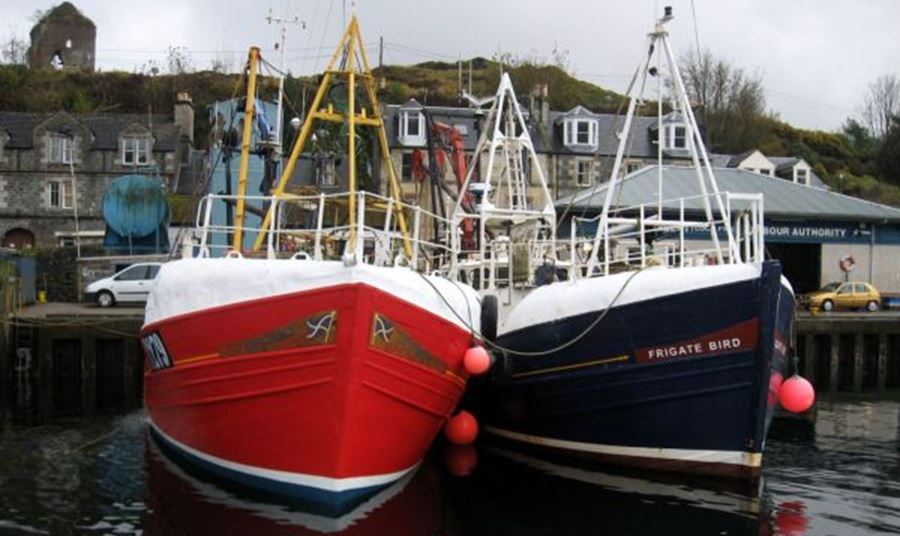
Today, prawns, scallops, lobsters and crabs are the main
catches landed at the modern Fish Quay. They come
from brightly coloured trawlers and creel boats equipped
with the latest in technical gear and fish-finding
computers. The neat brown skiffs may be gone but
many of the names and numbers on the bows of the
21st century fleet celebrate the long heritage and
continuing aspirations of Tarbert’s fishermen.
More information about traditional timber boats and ring
net boats can be found on
www.clydefishermenstrust.com, www.shemaron.co.uk
and www.castingthenet.scot